


- This event has passed.
Chesterton Perspectives brings you:
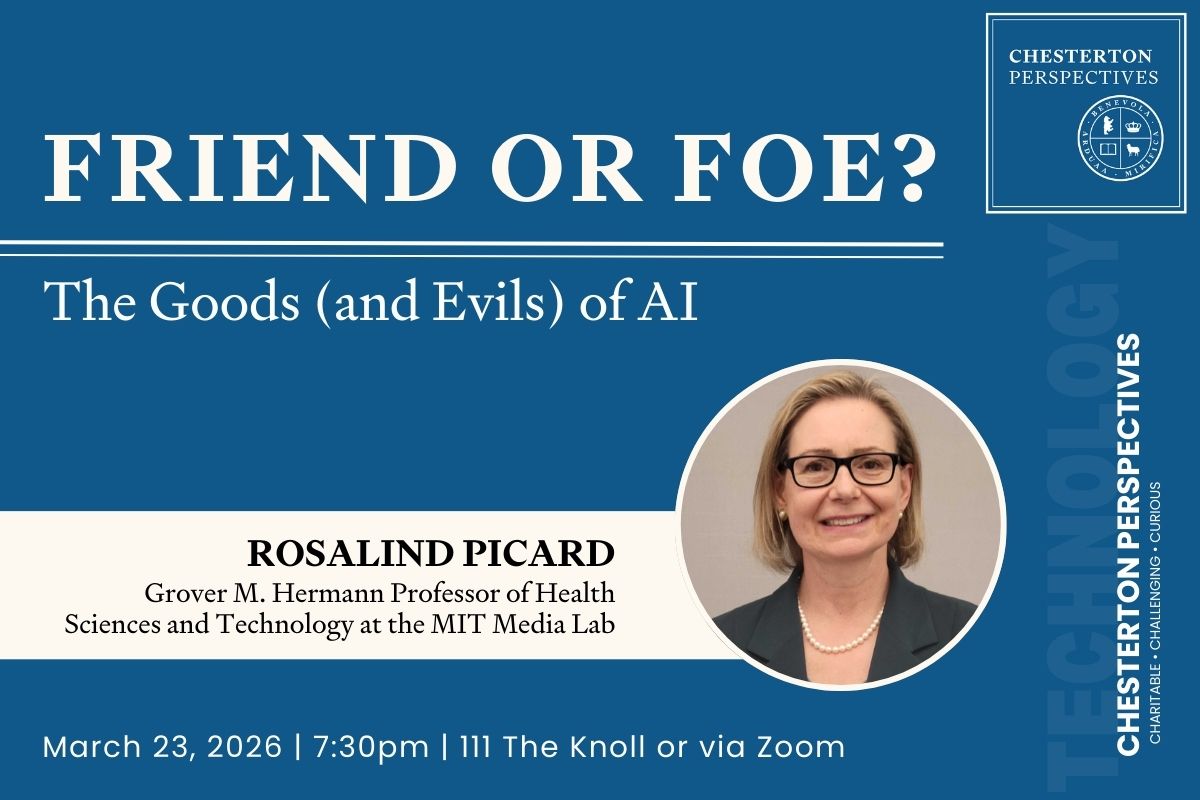
Friend or Foe: The Goods (and Evils) of AI
A conversation with Rosalind Picard, Grover M. Hermann Professor in Health Sciences and Technology at the MIT Media Lab
March 23, 2026
7:30 pm EST in person
7:45pm EST via Zoom
Nearly every day another article drops the headline: “Beware the dangers of AI!” The threats are manifold: the disintegration of human intellect and interpersonal skills; the replacement of human workers with humanoid bots; perhaps, some suggest, even the annihilation of the human race itself. These apocalyptic visions result in the reasonable call for caution and serious reflection on how AI shapes human flourishing.
But what if these dramatic threats are massively overstated? What if that future is far less likely than we fear? Could it be that, in the fervor of it all, we’ve forgotten some crucial things: that AI does not evolve on its own but has to be built, and that human beings remain responsible for what they create?
Might this doomsdaying be keeping us from exploring real benefits for real people: freeing them from menial and life-denying work, improving care for those vulnerable to seizure, and perhaps one day preventing most diseases?
And, what if the most harmful effects of AI are actually more hidden, less acknowledged issues related to mental health, addiction, and loneliness?
In other words, we need to think less about the visions of apocalyptic doomsayers and more about this human side of digital tech.
Join us as we welcome MIT Professor and AI researcher Roz Picard to Chesterton Perspectives. Recently interviewed by the BBC on these questions, she brings insight not only as a scientist and engineer, but also as an entrepreneur, inventor, and a Christian. Together, we’ll think through the goods and evils of AI and how to navigate this explosive topic as people of faith.
.
Rosalind Picard; Grover M. Hermann Professor in Health Sciences and Technology at the MIT Media Lab
Rosalind Picard is Grover M. Hermann Professor in Health Sciences and Technology at the MIT Media Lab, where she is founder and director of the Affective Computing Research Group, Associate Academic Head, and affiliated with the MIT Center for Neurobiological Engineering. She is the author of the book Affective Computing and co-author of hundreds of peer-reviewed science and engineering articles in artificial intelligence, digital health, affective computing, and human-computer interaction. An inventor on over 100 worldwide and US patents, she is co-founder and chief scientist of Empatica, providing FDA-cleared digital biomarkers and medical quality data and devices for clinical trials and research studies, and helping people with epilepsy and Parkinson’s. Picard is also co-founder of Affectiva, now part of Smart Eye AB. She is a popular speaker with a TED talk of over 2 million views. Picard is a member of the National Academy of Engineering, the National Academy of Inventors, and a fellow of the IEEE, ACM, and AAAC. She received the 2022 International Lombardy Prize for Computer Science Research, the 2025 Trotter Prize in Information, Complexity and Inference, and the 2026 IEEE Medal for Innovations in Healthcare Technology.