


- This event has passed.
Date
December 4, 2025 at 1:00 PM - 2:30 PM EST
Location
Guest Scholar:
A Conversation with Janet Soskice
Knowing God through Naming: The Interconnection of Metaphysics and Worship in God’s Names
What are humans doing when they name God? What are names of God for? How do names work? And how much do we need to know about God before we can name God in a coherent way?
Too often theology has been led to fixate on metaphysical problems connected to the existence of God and the intelligibility of God’s attributes. The name “God” is treated as a common noun whose correct use requires possessing a coherent definition of what God is before naming God as “God.” The result is a theological practice of metaphysical reasoning which aims at proving God’s existence by reference to God’s attributes but is divorced from the function of naming God for the purpose of being in relation to God.
But what if “God” is not just a common noun but also a proper name? Isn’t naming just as much about addressing God in prayer as it is about referring to God metaphysically? Do we need to be in possession of a list of essential properties before we call upon the Name of the Lord? Or can human God-talk get on just fine by knowing the commonplace meaning “God” has in the community using it?
Finally, might reconceiving God’s attributes as “names” referring to but also addressing God recall theology to remember that metaphysical reflection and devotional practice are meant to be interconnected in the task of theology?
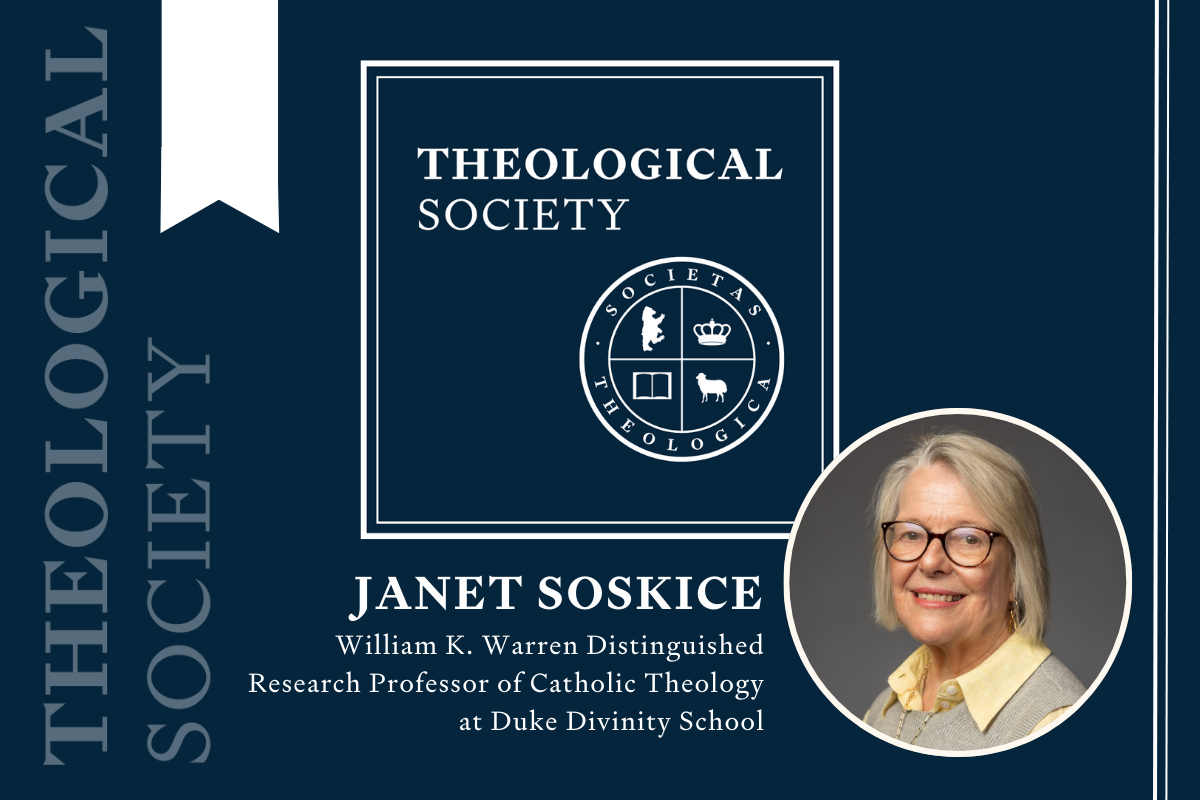
Join the Theological Society as we wrestle through these matters and more with Cornell alumnus, Janet Soskice, who is presently the William K. Warren Distinguished Research Professor of Catholic Theology at Duke Divinity School. Prior to her appointment at Duke, Prof. Soskice spent more than 30 years on the Faculty of Divinity at Cambridge University. She has authored many notable works, including Metaphor and Religious Language (Oxford: 1984) and most recently Naming God (Cambridge: 2023). She was featured on the “Best Book of the Year” lists in The Washington Post and The Christian Science Monitor for her book Sisters of Sinai (London: 2009).
Janet Soskice, William K. Warren Distinguished Research Professor of Catholic Theology
Dr. Soskice’s work lies at the intersection of Christian theology and philosophy. She has been particularly interested in questions of method and the Doctrine of God: religious language, metaphysics and epistemology, narrative and genre, doctrine of creation, women and religion, beauty and western art, science and religion, and theological writing. Her present large project, bringing almost all of these together, is on “Naming God.” For over 30 years, Professor Soskice was on the Faculty of Divinity at the University of Cambridge, where she is professor emerita of philosophical theology. She is a fellow emerita and past president of Jesus College Cambridge. Her books include Metaphor and Religious Language (Oxford, 1984); The Kindness of God (Oxford, 2007); joint editor of Creation and the God of Abraham (Cambridge, 2010); and Naming God: Addressing the Divine in Philosophy, Theology and Scripture (Cambridge, 2023). Her book Sisters of Sinai: How Two Lady Adventurers Discovered the Lost Gospels (London: Chatto and New York: Knopf, 2009) was read as Book of the Week on BBC Radio 4 and was in the “Best Book of the Year” lists of The Washington Post and The Christian Science Monitor. Dr. Soskice is a past president of both the Catholic Theological Association of Great Britain and the Society for the Study of Theology, and has been a Eugene McCarthy Visiting Professor at the Gregorian University in Rome and president of the Cambridge University Catholic Association. She is a member of the English and Welsh Anglican/ Roman Catholic Committee and takes part in Christian/Muslim dialogue.
THEOLOGICAL SOCIETY
This society seeks to gather Cornell faculty and graduate students to discuss major themes in biblical and theological studies. Discussion aims to satisfy what Simone Weil once described as the basic need of the soul to consider “every sort of opinion, without the least restriction or reserve.” To this end, we invite dialogue that explores and even challenges historic orthodox beliefs as well as those ideas that reign in the contemporary church, academy, and culture.
Our dialogue is collegial and cordial without shying away from the hard questions scholars face in their life and work. Members of the group seek to nurture discussion by listening attentively to one another, guarding the length of our responses, and avoiding diversions to pet issues unrelated to the subject at hand. In short, we seek to embody a uniquely Christian form of intellectual hospitality that we can pass on to future generations.