

Category: General
Gattaca
 GeneralMovie Review
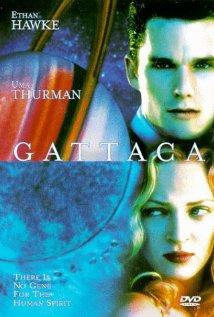
Set in the “not too distant future” Gattaca asks questions essential to defining the identity, value, and purpose of human life. Vincent Freeman is a “faith-child” (born the old-fashioned way) living among the elite superstars of genetic engineering. Yet Vincent is determined to realize his dream of doing what is reserved for the privileged and selected few – he wants to be a navigator on a rocket launch to Titan, one of the moons of Saturn. But to do this, he must borrow the identity of another.
What gives us dignity as people?
When are you good enough to make a difference?
What is perfection?
Who am I trying to please and whose approval matters most?
The subject of eugenics, genetic manipulation, selective breeding, and utopian idealism is hardly new. With the birth of Dolly, few doubt that a human clone is far behind if not here already. Crude attempts at human engineering have not been limited to Nazi Germany. Recently 30 US states publicly apologized for their role in the eugenics movement in this country and the incalculable human damage done in the name of eugenics. The government admitted to the forced sterilization of 8,000 mostly poor, uneducated men and women in an attempt to eradicate hereditary “defects” and chronic social problems such as poverty, immorality, crime, addiction and ignorance. Ah, what price we are willing to exact upon others so that we may enjoy life as we think it should be. What immeasurable corruption lies within the hearts of those who want life and people to be “just right.” With a subtle and quiet power, Gattaca shows us a world that is not too unlike our own, the world our world might easily become.
Gattaca is an elegant, stylish, and thoughtful sci-fi thriller. The lead roles are well acted by Ethan Hawke, Uma Thurman, and Jude Law. The story works as a classic triumph of the human spirit (“there is no gene for the human spirit”), as well as a murder who-dunnit and a sci-fi morality tale. Director Andew Niccol’s debut creates a stunning panorama in which he tells a superb story that is filled with simple profound questions that haunt the soul and invite us both to look within and to the heavens above.
-Steve Froehlich
Hard Day’s Night
GeneralMovie Review
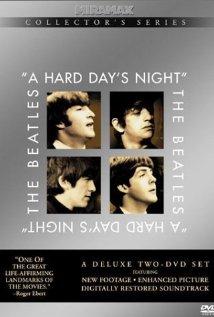
John is gone. George is gone. Paul is now Sir Paul. Ringo is… Where is Ringo anyway?
2004 marks the passing of 4 decades since Richard Lester (director) and “the boys” gave us A Hard Day’s Night. For the Beatles the release of the film in September 1964 framed a sensational year that began with their first appearance on the Ed Sullivan Show on February 9, an event witnessed by an unprecedented 70 million television viewers.
From the moment the images of A Hard Day’s Night first hit the screen, the film has occupied a prominent and important place in American cultural iconography. Many have suggested that the extraordinary impact of the film was helped by the timing of the British musical invasion – The Beatles made their prime-time television debut just 3 months after the assassination of President John F Kennedy, and the film burst to life on American movie theatre screens only days in advance of the first anniversary of Kennedy’s death.
A Hard Day’s Night is recognized as an important film because of the role it played in film-making. It is not remembered for its masterful scriptwriting, although it has lots of Pythonesque quips and repartee that impishly make their way into witty conversation. It’s not renowned for its character development – The Beatles are the characters playing themselves, and it’s the film’s job to get out of the way so we can see them. The film is the first rock video in which the film serves the music and the performers (quite unlike the Elvis, Frankie, and Annette films that required some sort of story, no matter how thin, to create an excuse to introduce the music).
In ways somewhat similar to post-war theatre that was breaking down the conventions of formal staging – pressing through the proscenium, coming face-to-face with the audience, dragging the audience into the experience, shamelessly propagandizing – the film broke free from the waning generation of movies featuring rock ‘n roll stars like Elvis Presley. But Elvis’ bad boy image existed within tightly scripted romantic storytelling. A Hard Day’s Night introduced a new level of realism in the tone of movie story-telling and in the relationship of the screen personality and the audience. The film feels like a home movie with the kids mugging for the camera knowing that they are on film and that the audience is watching them. The film is not a mockumentary a la Christopher Guest’s A Mighty Wind and Best in Show – it is an uninhibited invitation to enter the life of the Beatles for a day and play, and with all the playfulness aside it is an attempt to make us feel like we have really gotten to know “the boys.”
Lester, while not the inventor, was a big-screen innovator of the hand-held camera. The camera movements led to a fast-paced quick-cutting editing style that deconstructed the video line of the movie – he gave us quick hits and sound bites in a realistic setting that suggested a new speed of life. Life is fast, energetic, sudden, emotionally charged, orgasmic. Life is exhilarating, but exhausting. Life is buoyant, but smothering. What do I do when I need to escape, get away, find myself? Yet, I am unwilling to completely detach myself from the energy of the crowd.
There is in A Hard Day’s Night a seamless and perhaps unconscious weaving together of technology and life. We see lives in which media, images, and information are beginning to blend together in ways that today we recognize as normal, but was quite new at that time. It seems to be an admission or a realization that we had become a media culture. It was a kind of techno-confession that we in fact do… and in fact want to look at the world through an artificial lens… perhaps because we find that view more interesting, or more palatable. Perhaps we wanted to hide; perhaps we were hoping to find a better world; perhaps because the world as we were coming to know it was too much to bear.
We will never see “the boys” more innocent than they appear in this film. We will never see the movement which this film inaugurates more idealistic and joyful.
But we still have the music.
-Steve Froehlich
Minority Report
GeneralMovie Review
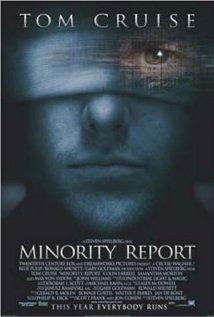
“You’d think we’d have found a cure for the common cold by now,” opines Director Burgess as he blows his nose. In the year 2054, there may be no cure for the flu, but the Bureau of Pre-Crime claims that they have found a cure for murder. The Washington DC that we know as a madhouse of murder has been transformed by the mid-21st century–murder has become a thing of the past thanks to the new police system that prevents the crime before it happens.
“Minority Report” is director Stephen Spielberg’s stylish techno-thriller based on the science fiction short story by Philip Dick. “Blade Runner” and “Total Recall” were also inspired by Dick stories, and “Minority Report” is repeatedly compared with “Blade Runner” as a visionary, provocative sci-fi cinema.
Science fiction of every literary form focuses on social and political rebellion and transformation. Something needs to change. However, living in the present we cannot see clearly because we are too familiar with life as it surrounds us. So, science fiction prophets change the setting to a world in which both our hopes and our nightmares have become a reality. “Minority Report” takes us forward only half a century from the present, and the changes to life-as-we-know-it are not outside the universe of what we can conceive might be possible (okÉ the elevator cars might be an exception). So, while philosophical in tone and futuristic in style, “Minority Report” maintains a sense of the present as it explores the ideas that shape the story. Therein lies much of its power–we can’t write if off as something that could never happen.
In the film Washington DC has become the safest city in the U.S. because the Department of Pre-Crime has found a way to prevent murder before it happens. Three children, specially gifted with pre-cognition, are able to see murder before it happens. They are literally the brain-center of the Department of Pre-Crime–they exist in a semi-comatose state in a bath of fluids. The images that appear in their brains are wired to computer screens monitored by the Pre-Crime police–they see the crime-to-be-committed, and the police run to the scene of the would-be crime to arrest the criminal before the commission of the act. So, the images and ideas of the film set up several serious questions.
In the wake of the 9/11 terrorist attacks in New York City, what price are we willing to pay to feel safe? The motto of the Pre-Crime unit is: “That which keeps us safe also keeps us free.” We are living in a changed world after 9/11, and many people live with heightened fear and anxiety. Many of us have envisioned draconian security measures that have become necessary for us to continue to feel secure in our homes.
Serious crimes require society to take serious action. Who hasn’t wished that someone could have intervened in time to prevent the senseless taking of life? If hindsight is 20/20, wouldn’t it be great to have that knowledge in advanceÉ assuming, of course, that we would put that information to honorable use. What is more honorable than saving lives?
Our pursuit of justice is many times energized by the evil we have experienced. So it is with John Anderton (Tom Cruise), chief of Pre-Crime. His little boy was kidnapped, right under his nose, 6 years ago, and he is haunted by what he could have done to prevent that crime from occurring. He is determined to do whatever is necessary to make sure that a crime like that never happens again–that no parent ever endures his pain. What could be more universal that the desire to shield one another from suffering and harm?
The film raises questions about personal safety, fear, justice, protection, power, checks and balances, criminal prosecution, government, privacy, and the sanctity of life. Like most science fiction, “Minority Report” does not answer all the questions it raises, but it does manage to fix a glitch in the system.
There is a cool, clinical mood to much of the film. Cinematographer Janusz Kaminski (“Schindler’s List”) paints the screen in sleek, steely blue. The tone is indifferent and detached (yet, the chrome-like scheme suggests speed, suddenness, steely-swift justice) pointing to the depersonalizing consequences of the technological advances being championed. The Pre-Cogs do not give their gifts for the good of their neighbors, but their brains are used thanklessly–they are little more than machines. Individuals lose their identity to the scanners and optical readers that monitor their movements–their names are shouted out by digital billboards (designed to make advertising personal), their movements are tracked (because if we want to be protected we have to be found when we need help). As we watch this future world, we find that all the technology makes sense–we can see ourselves wanting it in our lives for the same reasons the characters in the film probably welcomed it into theirs.
But is it too late to undo the madness?
“Minority Report” is about seeing. Stylistically it employs a vision of the future. But it also acknowledges an increasingly prevalent view of the world, and our view of our place in the world. To undo the tyranny, Anderton has to get new eyes, literally. He is blind to the immorality of Pre-Crime and the abuse of the Pre-Cogs. He has to stop his addiction to the drug “Clarity” that keeps him reliving the past. He has to interpret what the Pre-Cogs “see” when they predict that he will murder a man he does not know in 36 hours. He is a man known for integrity, and he thinks of himself as one who would never behave any other way–so he has to explore his own self, his motives, and “see” himself in a new way.
“In the country of the blind, the one-eyed man is king.”
In a way quite similar to “Brazil” and “Twelve Monkeys,” “Minority Report” is about control. Ironically, the savior figure is Agatha, one of the Pre-Cogs. Yet she is helpless. Her body is limp and weak, barely able to stand. There is an extraordinary cinemagraphic moment when Anderton is holding her–her head on his shoulder is looking back, he is looking forward, and their eyes tell all. Anderton believes that the Pre-Crime Department has found a way to control the evil of the human heart, but he discovers that even the Pre-Crime developers are corrupt. He set his eyes to look in another direction.
Finally, the film toys with some religious ideas and images. Perhaps most prominently it ponders the tension between predestination and free will, or fatalism and determinism. Can we change the future? Are we doomed to do what has been foreseen? If we cannot choose (and Agatha pleads with Anderton as he points his gun at the man the Pre-Cogs saw him kill, “You can choose!”), how are we not machines, and why should we not employ sophisticated technology simply to manage our existence? Michael Karounos writing in the “Journal of Religion and Film” observes: “The area where the Pre-Cogs are kept is referred to as ‘The Temple’; the police officers are called ‘priests’ and ‘clergy’; the punishment chamber for the future murderers is called a kind of ‘hell’; and the ‘handcuffs’ are an immobilizing headset which is referred to as a ‘halo.’ Moreover, there are three Pre-Cogs (constituting a kind of trinity) and the warden of the ‘death penalty’ wing is called Gideon.”
In “Signs” the wife of Graham Hess tells him with her dying breath, “See!” Open your eyes – stop walking around in a blind stupor. “Minority Report” asks us to see, too. Are we blind? Are we controlled by fear? Are we moral beings that have responsibility for the choices we make? Are we willing to change the way we see the world and embrace solutions to the problems that plague our cities and invade our lives?
“Minority Report” is brilliant visually with solid performances by Tom Cruise, Colin Ferrill, and Max von Sydow. Samantha Morton is mesmerizing as Agatha. It’s a long film–2 hours and 20 minutes. We will start the film on time so we will have some time for discussion afterwards.
-Steve Froehlich
Midnight in Paris
GeneralMovie Review
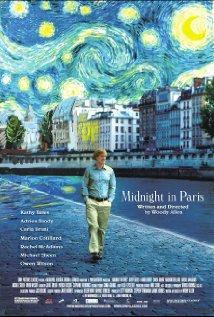
As Roger Ebert says, “There is nothing not to like about this film.” Indeed. From my first viewing, I was thoroughly charmed.
Midnight in Paris (2011) is a pleasant potpourri of literary devices: love, longing, Paris, famous people, and a bit of time travel. Of course, since it’s a Woody Allen film, in some way you can be sure it is about him – don’t all of his films have an autobiographical narcissism? But in this case, it’s easy to look past his doleful eyes and enjoy the film. Owen Wilson (Gil) and Rachel McAdams (Inez) as the leads are pitched just right, and the contrast set up among the other principals is structurally compelling and satisfying. Kathy Bates, Adrian Brody, and others have delightful cameo roles. The time travel device works (besides, it’s Paris and it’s supposed to be a magical city, right?). The story is thoughtful enough and sweetened by some deft brushes of romance. Visually it is artful and alluring – the visual style is part of the idea of the film, and art (something of a composite character) has a voice in the story.
The myth of the golden era. Many of us live in the grip of nostalgia, the desire for something different, the illusion of something better, a sour discontentment. The grass is always greener…. Gil is a screen writer by day who has written a novel. The literature of television is fleeting to him, something so insubstantial it can be switched off. But the world of the novel is enduring and significant in part because it is tied to the past. The problem is that the screen writing pays the bills• the bills Inez is racking up by all her indulgent spending. She cannot imagine that Gil would want something more than what he has, and consequently offers him no encouragement. So, the search for guidance and illumination plays out in the classic city of the arts, Paris. Here, Gil has to find his way. Settling for the way things are in the present, while practical, is a decidedly unfulfilling prospect. Reaching for his ideal is a risk that will require him to let go of some of the security of the present. Gil’s courage to “go for it” is energized by nostalgia, the subject of his novel. He looks back romantically at the icons of a golden era who dared to do what he longs to do. But as he does so he realizes that he can be seduced by romantically idealizing the past, or he can learn from the past, an act that will require humility.
These are important questions for us as Christians. With what perspective do we pursue our life goals? Many of us are trapped by many forms of idealism. Gil looks to the past for salvation even as we do. The historical reality of the Cross, Resurrection, and Ascension are the foundation for all the historical ground which follows. That ground beneath our feet gives us joy and hope. In Christ, the long arm of the past defines the present and persuades us that even in spite of sin the work of Creation continues so that by grace humans can flourish. We can have dreams, and they are worth pursuing.
Woody Allen would say, I think, that Gil is saved by art. We would say, by the Artist. But the role of art, the grace of the Artist, is no less profound for us. The present and the future for us have little significance unless we value the past and humbly learn from it.
-Steve Froehlich
Lost in Translation
GeneralMovie Review
I lost a world the other day.
Has anybody found?
~Emily Dickinson~
So many words; so little understanding.
So many images; so little presence.
So much light; so little warmth.
So many people; so little friendship.
So much solitude; so little peace.
So many distractions; so little happiness.
So many comforts; so little rest.
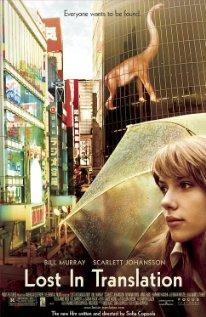
Lost in Translation, an important film for our time, gives words and images to the lost loneliness of our generation. The deep longing of our heart for what we want more than anything, more than sex. To be found, to be understood, to belong, to be human.
Bob (Bill Murray) and Charlotte (Scarlett Johansson), surrounded by all things affluent and larger than life, lonely, meet in the ultramodern Tokyo hotel and share a friendship wrapped in sweet comic sadness. Bob, a famous big-screen actor whose glory is fading, has come to Tokyo to shoot a commercial for Santory whiskey. Has his career come to this? Is he anything more than the digitally-projected image he has created? His media-enriched persona is recognized internationally, but does anyone know who he is? Charlotte, newly married, has come to Tokyo with her husband, a photographer whose driving ambition is capturing the images of rock stars and beautiful people. Has intimacy been lost to infatuation? Will she have value and meaning apart from becoming yet another icon captured in her husband’s lens? Her husband is passionate about immortalizing the fame of celebrities, but will he be content to walk with her in the very mortal world of hopes and hurts?
Lost in Translation is an exquisite film, magnificently conceived and created by Sofia Coppola. This is only her second feature film (The Virgin Suicides, 2000), but she has undoubtedly inherited much from her father, Francis Ford Coppola (Godfather trilogy), a film legend. David Edelstein (Slate) says that she “put the longing for human connection into your bloodstream from the first frame.” Indeed, she does. The performances by Murray and Johansen are tremendous — certainly Murray’s finest hour worthy of the Oscar nomination awarded him.
As you watch the film, absorb many of its subtle elements. Sound, and the way the noise of the world falls on the ear of someone who is lost and disconnected. Light, and the way the world is illuminated to someone who longs for a hopeful tomorrow. Windows, and what a panoramic view of the world brings to someone who is lonely. Images, and how someone without a certain center is known. Desire, and the hunger for something more than physical gratification. Distance, language, a shirt, a wig, reflections in glass — all these provide harmony to the major melody of Lost in Translation.
Are the faces reflected in the window our own, or perhaps well-crafted projections that mask our true self? Is the ironic laughter floating across the room the sound of a heart longing to be known, loved? The sights and sounds of Lost in Translation are all familiar to the world as we know it, but do we understand what those sights and sounds really mean?
-Steve Froehlich
CONTACT
GeneralMovie Review
For the Cornell community, the importance of the film CONTACT goes far beyond the fact that it is based on the 1985 novel by famous Cornell professor and scientiest, Carl Sagan. It is emblematic of issues formative to the founding of the university.
The debate over the relationship between science and religion is a topic that energized the thinking and vision of A.D. White, Cornell’s co-founder and first president. Cornell was founded in 1865 in the first full blush of the Modern Era, and the rise to prominence of Enlightenment Humanism that aggressively pitted naturalism against super-naturalism, and reason against religion (i.e., historic Christianity). In 1896, White published his 2-volume, The History of Warfare of Science with Theology in Christendom. White takes over 700 pages to document the success of German Higher Criticism in deconstructing and dehistoricising main-line views of the Bible, Jesus, miracles, and faith in God. Cornell University is (or at least was) the incarnation of his belief that the war was over. Here are some of White’s concluding remarks:
“For all this dissolving away of traditional opinions regarding our sacred literature, there has been a cause far more general and powerful than any which has been given, for it is a cause surrounding and permeating all. This is simply the atmosphere of thought engendered by the development of all sciences during the last three centuries…. Vast masses of myth, legend, marvel, and dogmatic assertion, coming into this atmosphere, have been dissolved and are now dissolving quietly away like icebergs drifted into the Gulf Stream” (716).
“Sciences are giving a new solution to those problems which dogmatic theology has so long labored in vain to solve…. If, then, modern science in general has acted powerfully to dissolve away the theories and dogmas of the older theologic interpretation, it has also been active in a reconstruction and recrystallization of truth; and very powerful in this reconstruction have been the evolution doctrines which have grown out of the thought and work of men like Darwin and Spencer” (717).
Sagan held some very similar views. In short, one might say that White and Sagan believed that scientific ways of knowing trumped revelation, and therefore traditional or “revealed” religion. Yet implicit in their worldview are metaphysical assumptions of a decidedly naturalistic stripe. What comes through White and Sagan then is not “science” pure and simple, but philosophical naturalism–which is itself a kind of religion and a kind of faith. The new “scientific” view of the world turns out to be an ancient philosophical view of the world. It is therefore not surprising that CONTACT returns us to age-old questions:
“Should we take all this on faith? Is there an all-powerful, mysterious God that created the universe, but left us no proof of his existence? Or, is there simply no God, and we created him so we wouldn’t feel so alone?”
Until his death, Carl Sagan worked closely with director Robert Zemeckis (Forrest Gump). The result is a thoughtful exploration not just of space and time, but of these ancient questions. Jody Foster gives a vibrant and mature performace as Dr. Ellie Arroway, a determined scientest who works with SETI (Search for Extra Terrestrial Intelligence). She has spent her life listening with a longing ear turned toward the stars. This is the story about what she hears, and how what she hears changes what she believes about science and about God. Ellie reflects:
“I had an experience I can’t prove, I can’t even explain it, but everything that I know as a human being, everything that I am tells me that it was real. I was part of something wonderful, something that changed me forever; a vision of the Universe that tells us undeniable how tine, and insignificant, and how rare and precious we all are. A vision that tells us we belong to something that is greater than ourselves. That we are not, that none of us are alone. I wish I could share that. I with that everyone, if even for one moment, could feel that awe, and humility, and the hope, but… that continues to be my wish.”
12 Monkeys
GeneralMovie Review
“Solving the riddle of 12 Monkeys is an exhilarating challenge,” says Peter Travers of Rolling Stone. Terry Gilliam (Time Bandits, The Fisher King, The Adventures of Baron Munchausen, Fear and Loathing in Las Vegas, and The Man Who Killed Don Quixote… well, not quite) has created an apocalyptic puzzle that dismembers time, like a surgeon performing an autopsy, so that we can explore what makes science tick–the science that unravels how the mind works, how the world goes, and how the heart sings. When Cole (Bruce Willis) the time-traveler meets Goines (Brad Pitt) the fingernail-chewing son of a famous virologist, Goines opines, “The problem with science is… it’s not an exact science.”
Cole comes to the past (1996) from the present (2035) with the knowledge that 5 billion people have been extinguished and the surface of the earth rendered uninhabitable by a deadly virus that has been unleashed upon humanity. Cole is a criminal who survived the holocaust because he was isolated in prison, and he is given a mission that may earn him his freedom if successful–he is to return to 1996, find the deadly virus, and bring a sample back to the present (the future) so that it can be analyzed.
Time travel is much more than a clever device in this story–it is a way of tilting our vision of time so that we can think about the role of knowledge and power… of inevitability. Have the survivors, now in control of the ruins of civilization learned anything from the holocaust, or is the cold clinical reality rather that time plus knowledge has not changed them at all? Is knowledge being used as power to make certain the outcomes of history?
Cole, like Cassandra in Greek legend, knows what will happen, yet he is powerless to convince anyone that what he knows is true. Cole is surrounded by those who would use their knowledge to control the future. Psychologist Kathryn Railly (Madeleine Stowe), whose relationship with Cole moves from clinical detachment to loving compassion, eventually questions the science behind her psychological expertise: “I mean, psychiatry: it’s the latest religion. We decide what’s right and wrong. We decide who’s crazy or not. I’m in trouble here. I’m losing my faith.”
Cole speaks like a seer. He knows the future and he hears voices of those who share his knowledge. He is a prophet, yet he is not a messiah. He searches for the secret cult, the 12 Monkeys, the true believers who know that his vision of the future is true. So, what are the 12 Monkeys? Is the symbol used by the group, 12 monkeys arranged in a circle, meant to resemble a clock–time, inevitability, the future, the past. Is the number 12 a prophetic apocalyptic icon? Are the monkeys baring their teeth in mock laughter as if to ask us which side of the cage bars we are on–are we really free… or in the grand evolutionary scheme, have we really progressed all that far?
David Peoples (Unforgiven, Blade Runner) and his wife, Janet, worked from Chris Marker’s 1962 short film La JetTe, a classic piece of French avant-garde cinema, to create a screenplay filled with their own vision of a future haunted by the past. Terry Gilliam has created a haunting visual story filled with images and ideas that will linger in your mind and draw you back for a 2nd look, a 3rd look… Great films and great filmmakers have the power to do that.
-Steve Froehlich
About a Boy
GeneralMovie Review
Will Freeman is a the character we suspected has been tucked behind the veneer of the superficial personalities embodied by Hugh Grant in many of his films. He is, as James Berardinelli so neatly describes, “the ultimate slacker. Living off the royalties of his one-hit-wonder father’s Christmastime jingle ‘Santa’s Supersleigh’, Will is proud of never having had a job or, indeed, having done much of anything. He’s not interested in a serious relationship–casual sex and one-night stands are his forté. Then, one day, he makes a mistake. On the prowl for easy female prey, he ventures into a single parents’ group meeting. Soon, he is dating a woman who is babysitting for her friend’s son, Marcus (Nicholas Hoult). This wouldn’t mean much to Will, except that Marcus takes a liking to him and decides that Will might be the perfect match for his emotionally disturbed mother, Fiona (Toni Collette). Then the strangest thing happens–Will and Marcus strike up an unusual friendship. But complications ensue when Will falls for another single mother (Rachel Weisz) and wants Marcus to pretend to be his son.”
There it is–a simple, even familiar, plot line. However, what draws us into this film based on a novel by Nick Hornby (his work also was the premise for High Fidelity), what hooks us is the realization that we are looking at 2 children–one is truly a child, Marcus, while other is a 38-year old child, Will. Will has every boredom-eliminating toy imaginable, yet is lonely, seemingly incapable of thinking of anyone other than himself. In a futile pretence of squeezing some sort of meaning into his empty life, Will divides his existence into half-hour increments and vows never to mean anything to anyone. He declares himself to be an island, and ponders, “How do people manage to fit in a full-time job?” He looks at life as “the Will show,” which is not an “ensemble drama.” He is in every way clueless, selfish, and immature.
The irony of the story is that Marcus, who scratches his way through a bullied life at school and an emotionally terrorized life at home (his depressed mother is suicidal), knows that the one thing he desperately needs is one stable parent. Ok, an older person who looks like a parent. And, yes, it’s ok that he happens to be rich. Marcus has the maturity to press through Will’s immaturity to make the father-son connection stick. That is the heart of this charming film.
The name, Will Freeman, says something to us about the commentary this character makes about our lives and priorities. Will has the appearance of freedom. He can do what he will. He is an Everyman. He is the caricature of what is held up as the icon of success. He has arrived materially, but his soul remains lost in the woods. Not only is he a lost soul, but he has a terrible time understanding the real dilemma of his condition–he has bought into the pretense of life so deeply he has mistaken it for the real thing. Marcus’ life is a surreal rollercoaster and a prison at the same time. He wants to be free. He wants to be found. But he knows that it must come as a gift from someone who is willing to love him.
This story parallels the classic Beauty and the Beast tale in which the Beast has to learn that he is a beast. But Will, the teen-idol beast in this film, represents much of what we as a culture value and aspire to be–at first glimpse, he doesn’t look beastly. But his bored life is laughable, comic, and so are our lives when we chase what he chases.
About a Boy, directed by Paul and Chris Weitz, teases out the meaning of Jesus’ words: “Whoever finds his life will lose it, and whoever loses his life for my sake will find it” (Matthew 10:39). When Will and Marcus give to each other and receive from one another the gift of honest and mature friendship, we cheer.
-Steve Froehlich
Questions for discussion:
- Will values living as an island. In what ways do we either value or permit ourselves to be drawn into lives of isolation?
- How keeps us from making real, giving friendships?
- Why do you need friendships – what aspects of your life or experiences in your life have convinced you that you must form significant friendships?
- Will is a user. In what ways do you use people simply to get what you want? Marcus is a fighter. In what ways have fought desperately for what you know is of great value in your life? Once you got it or reached your goal, was it worth the means you employed to get there?
- Why do you think God designed humans to forge deep human relationships? What does that need or those friendships teach us about God?
- Will pretended to be busy so that he would have an excuse for not becoming attached to people around him. In what ways do we busy ourselves in the same way? Once Will’s eyes are open to the world around him, once our eyes are opened, what are some of the things he and we see that we’ve been missing?
- What makes a friendship mature and significant?
Autumn-Spring
GeneralMovie Review
It sounds much too bland to ask: How would you live today if you knew that it were your last? For someone who really did care about squeezing every drop of living out of life, the proposition must be framed with much more imagination. For instance, Is the joy of watching the poor bus driver go into a wild-eyed panic because you have stepped out in front of his oncoming bus a fair exchange for the very real possibility of have having your ticket permanently punched a few days early? Frantisek Hána (Fanda) would have to give it serious consideration. It would be quite a show, one worth seeing. If he took that step off the curb, you can be sure he would stand facing the mayhem bearing down upon him with a bemused calm that would allow him to absorb the full effect of his mischief.
Autumn-Spring is a gem of Czeck cinema featuring the acclaimed veteran duo of Vlastimil Brodsk and Stella Zázvorková as Fanda and Emílie, roles for which they were awarded the Czeck Lion. The married couple is in their autumn years. Emílie insists on using their time and resources for the practical necessities of preparing for the inevitable so that they are not a burden on anyone else. Fanda, however, is stoical about such mundane matters—his imagination and playfulness are alive even inside his aging body and he will have nothing to do with living practically and “going quietly into that good night.” He and his all-too-willing accomplice, Eda, are busy scheming up their shenanigans: posing as subway agents so they can steal kisses from pretty passengers who don’t have the proper fair, posing as a retired opera conductor and assistant while allowing greedy real estate agents wine them and dine them in hopes of a lucrative sale.
This is a film touched by the Eastern European pessimism or sadness that comes from nearly a century lived in oppression. The actors themselves have weathered their homeland’s bleak hours, so their performances function as a somewhat unintentional testimonial to people who have waited to die well. The film assumes that death is inevitable—that much is not in debate. But it does ask us how we will live, regardless of our age, as people who are dying.
Fanda doesn’t really want to cheat death—he simply does not want to give up on the joy of life a moment too soon. However, his determined refusal to be practical exposes a deep root of selfishness and self-centeredness. His own thrill-seeking and joy-riding eventually reveal how unwilling he has been to be loving toward others, especially his loyal and persevering wife.
Autumn-Spring shows us Fanda and Emílie having grown old together, but it is not essentially a film about old age or death, although death is always present. In a much more charming and often amusing manner it echoes the line from William Wallace in Braveheart: “Every man dies, but not every man really lives.” It reminds us of the power which humor, imagination, and joy have to literally sustain our lives. It asks us to think about the relationship that love and personal happiness have to one another.
Director Vladimír Michálek gives us a simple unadorned film so that the characters come alive with depth and dimension. Yet, the simplicity functions as a powerful reminder that great joy in life does not come from those distractions that often complicate our lives. Childlike Fanda uses only his imagination to make a playground out of a world which knows little of the adult gadgets and toys that keep us busy and distracted, weary in our drivenness.
The film’s subtitles are well-translated and capture much of the nuance expressed in the story and in the rich facial expressions of the characters. One of the great ironies of this hopeful and affirming film is that it marks the end of the life and career of Vlastimil Brodsk—he committed suicide shortly after the film was completed.
-Steve Froehlich
Questions for discussion:
- How does the film’s simplicity complement the theme of happiness?
- Why do you think Fanda is so indifferent to Emílie?
- Why do you think Emílie is so angry with Fanda?
- What is the source of the undercurrent of cynicism in the film?
- How and why do Fanda and Emílie change, if in fact you think they do?
- How does the film enlist your sympathies for the characters? Do your sympathies change? Why?
- Do you think the film is hopeful? Why, or why not?
- How does the film explore the tension between possibility and necessity? Between truth and happiness?